Browser games
Build a Tower Defense Game with AI: Waves, Towers and Fair Difficulty
Design a readable tower defense prototype with one route, three tower roles and testable waves. Use a complete prompt and balance checklist.
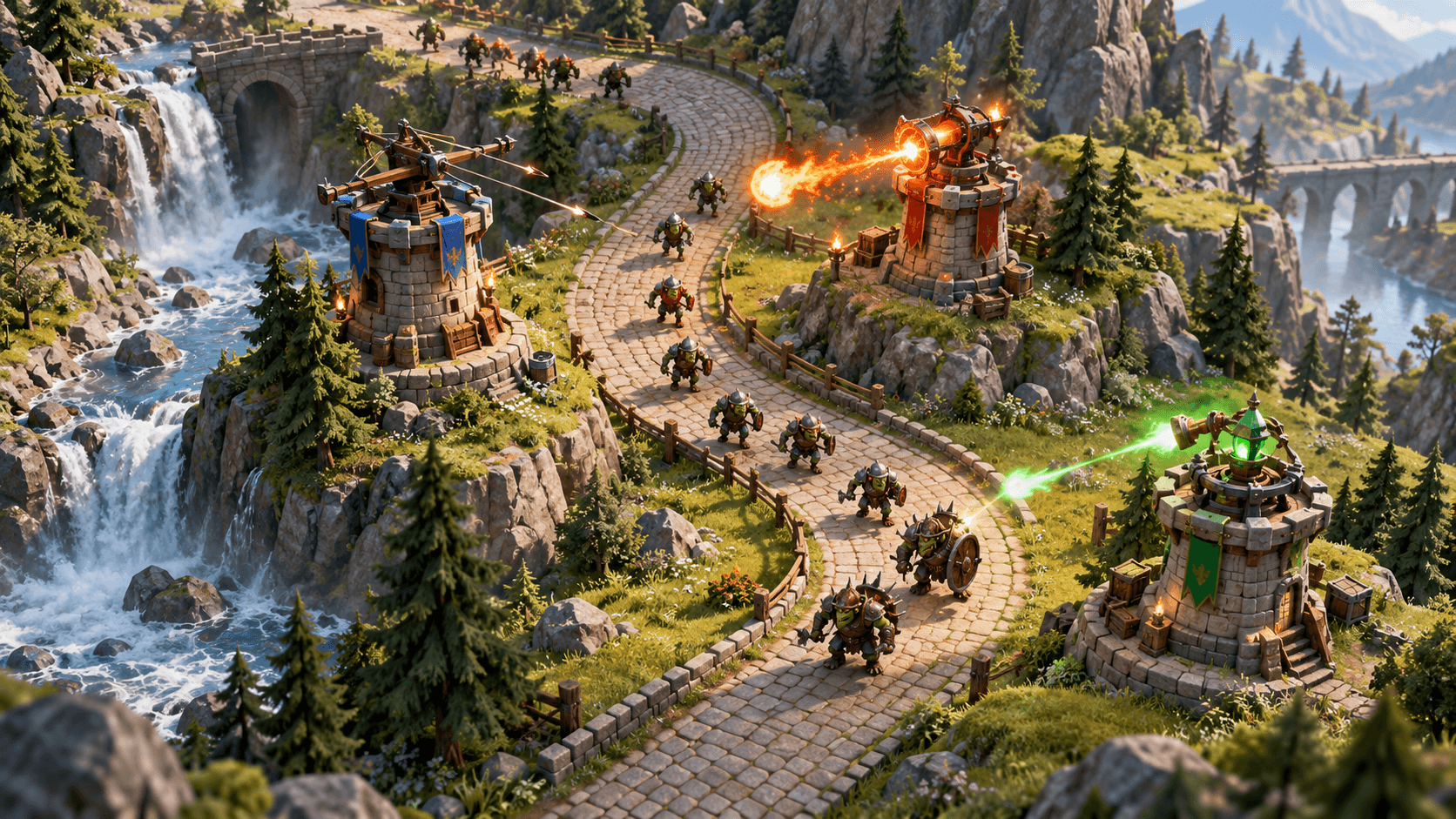
Tower defense works when the player can understand a threat, place a useful defense and see why the choice succeeded or failed. More towers and enemies do not automatically improve those decisions. One legible route and a few distinct tower roles can support a complete first game.
An AI brief should describe the economy and the wave rules as clearly as the scenery. Otherwise, you might receive an attractive battlefield with no meaningful reason to choose one tower over another. Use Buildr’s Browser destination to explore a compact version first.
Start with a route players can read
An S-shaped path gives towers multiple chances to reach enemies. Keep its entrance and exit obvious. Place build zones beside the route, and make unbuildable ground look different. The player should see where enemies travel without guessing from decorative roads.
For the first prototype, enemies can all follow the same fixed route. Path-building, branching lanes and flying enemies introduce additional rules. Save those ideas until a basic wave can begin, advance and end correctly.
Give each tower a different job
Three roles are enough to create tradeoffs: a cheap rapid attacker, a slow area attacker and a slowing support tower. Their appearance should reinforce the distinction. A tower's range indicator is also useful feedback when the player is deciding where to build.
| Tower | Useful situation | Tradeoff |
|---|---|---|
| Rapid attacker | A steady stream of single enemies | Limited damage to a packed group |
| Area attacker | Several enemies close together | Slower attack rate or higher price |
| Slowing tower | Enemies passing several damage towers | Low direct damage |
Avoid giving every tower the same range, price and attack pattern with different colors. That creates a cosmetic choice instead of a strategic one. Introduce upgrades only after the basic roles feel distinct.
Make the economy visible
State the starting currency, tower prices, enemy rewards and lives. These are test values, not a promise of perfect balance. For example, start with enough currency for two cheap towers or one expensive tower. This creates an initial decision that you can observe.
Show a disabled build action when the player cannot afford a tower. Do not silently accept the click or let currency become negative. A defeated enemy should award currency once; an escaped enemy should remove the intended number of lives once.
A complete first prompt
Build a browser tower defense game with one S-shaped path, clearly marked building pads and five short waves. Give the player 120 starting coins and 10 lives. Include a rapid tower costing 60, an area tower costing 100, and a slow tower costing 80. Show range before placement and make unaffordable choices visibly unavailable. Enemies follow the path, reward coins once when defeated, and remove one life when they escape. Start each wave only when the player clicks Start Wave. Show the current wave, remaining enemies, coins and lives. Add a win state after wave five, a loss state at zero lives and a full Restart. Use original polished isometric fantasy art. Treat these numbers as initial tuning values.
The explicit values make failures easier to reproduce. If the first wave is impossible, change starting resources or the wave composition before increasing every tower's damage.
Balance with repeatable tests
Play the first wave using only the cheap tower, then repeat with the expensive tower. Record how many enemies escape and how much currency remains. Try an intentionally poor placement. A strategy game should allow mistakes, but the consequence should be understandable.
Later waves can introduce faster enemies or tougher groups one at a time. Increasing speed, health and count together makes it difficult to identify what caused a difficulty spike. A wave preview helps players respond to a new threat deliberately.
Catch the less glamorous bugs
Test clicking Start Wave twice, restarting during combat, and placing a tower on an occupied pad. Check that defeated enemies stop moving, projectiles disappear appropriately and rewards do not duplicate. These checks matter more to the experience than a bigger particle effect.
Use the AI debugging guide to report a repeatable failure, and the browser-game guide for the full playtest flow. When the basic loop works, return to Buildr with one targeted improvement. Paid generation depends on model availability and credits; test the result before publishing it.
YOUR NEXT BUILD