Browser games
Make a Puzzle Game with AI: Teach One Rule, Then Surprise the Player
Design a small puzzle room with a clear rule, reliable reset and readable feedback. Includes an AI prompt, clue checklist and playtest questions.
A good puzzle makes the player think, “I understand the rule; now I need to use it differently.” A confusing interaction makes them think, “I do not know what the game accepts.” When you ask AI to build a puzzle, specify both the rule and the feedback that teaches it.
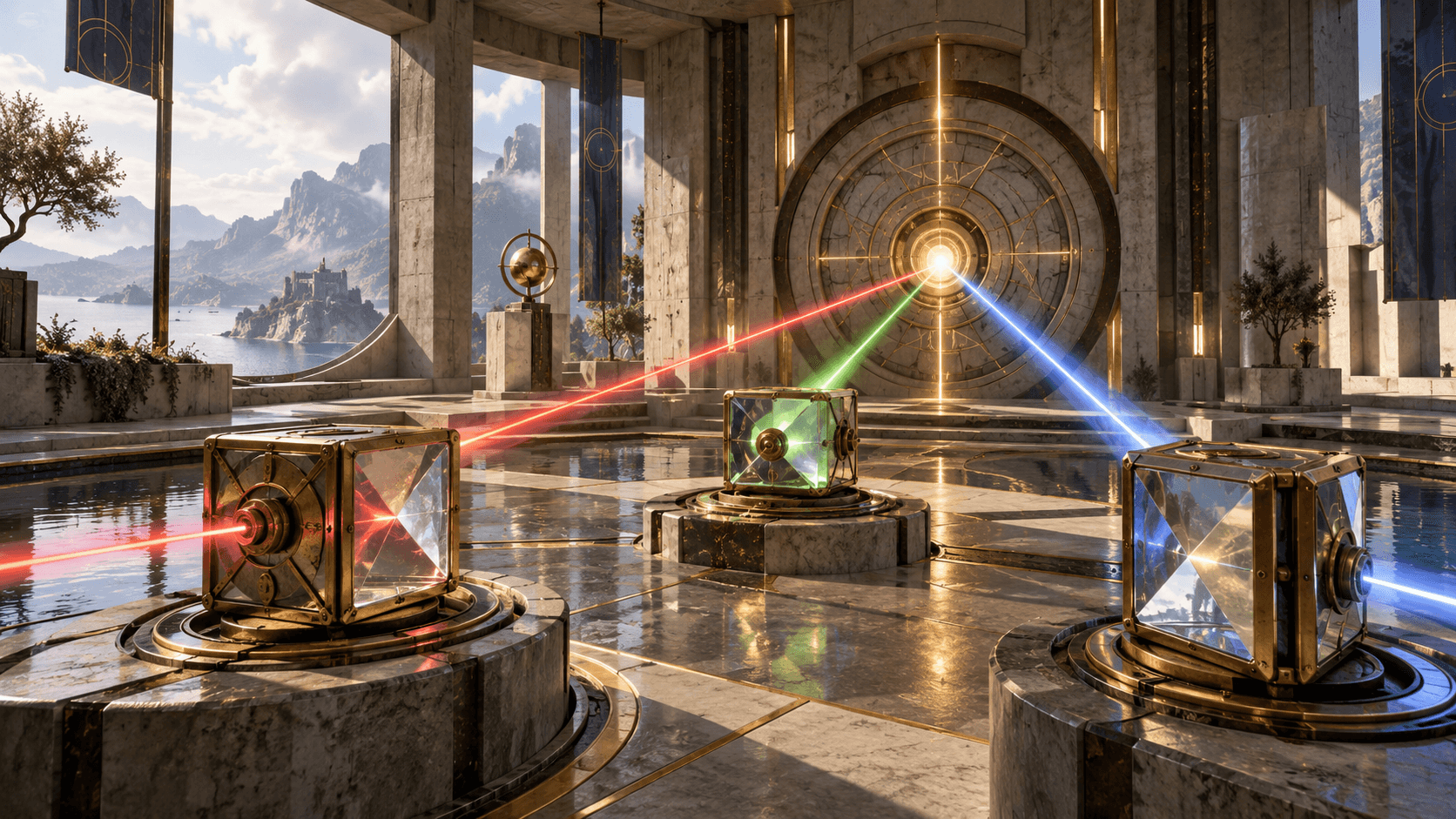
Start with a small light-and-prism room. The objective is to route a beam into a receiver to open a door. That premise can support a readable prototype without dialogue, inventories or a large map. The cover illustrates a possible visual direction; it is not a captured Buildr playtest.
Write the solution before the prompt
Describe the shortest valid solution in plain language. For example: move one prism onto a marked tile, rotate it to redirect the beam, then activate the receiver. If you cannot explain the solution, the generation brief will probably leave important rules undecided.
Next, list the legal actions. Can prisms move freely or only between grid cells? Do they rotate in fixed increments? Can the player carry more than one? A small set of exact interactions is easier to learn and test than an unrestricted physics simulation.
Teach the rule in an easy first room
The opening room should demonstrate one relationship between action and outcome. Put a prism beside an obvious target tile and show the beam's direction. When the player rotates the prism, the beam should change immediately.
A second room can require two prisms. A third can combine a known action with a new obstacle. Keep the visual language consistent: if a white ring means “movable” in room one, it should still mean that in room three.
| Element | Information it should communicate |
|---|---|
| Movable prism | This object can be selected or moved |
| Rotation control | The current direction and next step |
| Beam | Where light is going now |
| Receiver | Whether the current configuration is valid |
| Exit door | When the puzzle is complete |
Ask for a fair reset
The player will experiment. A reset button lets them recover without losing the whole session. Reset should restore objects, beams and completion state together. Specify whether restarting a room also restarts the timer, if a timer exists.
Avoid irreversible states in the first version. A prism that can fall out of the level can turn a thinking game into a recovery problem. Constrain movement to legal tiles and keep the solution reachable from every ordinary move.
A starter prompt for three rooms
Build a browser puzzle game with three compact rooms and a fixed overhead camera. The player moves brass prism cubes between marked grid tiles and rotates them in 90-degree steps to direct a light beam into a receiver. Room one teaches one prism, room two combines two prisms, and room three adds one blocked tile. Highlight selectable objects and legal destination tiles. Update beams immediately after each move. Clearly show when a receiver activates and unlock the exit only after the correct condition is met. Include mouse and touch input, Reset Room, a short optional hint and a final completion screen. Use an original observatory art style with clear contrast between interactive and decorative objects.
For a first-person version, explicitly describe how objects are selected and how the player sees valid placement. That change affects controls and camera behavior, so treat it as a separate version instead of a tiny visual edit.
Playtest without explaining the solution
Give a tester the controls, then watch. Can they identify the objective? Do they understand when a move is legal? Are they trying a reasonable solution that the game rejects for an unstated reason? Ask what they thought each object did before explaining its actual behavior.
A useful hint points toward the rule without listing every move. “The prism changes the beam's direction” preserves more discovery than “Move the left cube to the second tile.” Request one hint at a time rather than a permanent answer overlay.
Improve the clue, then the decoration
If players get stuck because a receiver looks like background art, change its shape or feedback first. If they understand the rule but solve every room instantly, add a meaningful constraint. More visual detail will not fix either issue.
See better game prompts for specifying interactions and mobile game controls for touch targets. Take the brief to Buildr when you are ready. Generation requires a paid plan and an enabled model; a convincing scene still needs a working solution and reset.
YOUR NEXT BUILD